CheckNumber.AI
· 4 min read
Netflix Account Detection by Phone Number: A New Signal for Business Verification Workflows
Learn how businesses use Netflix account detection by phone number for fraud prevention, risk control, and identity verification.
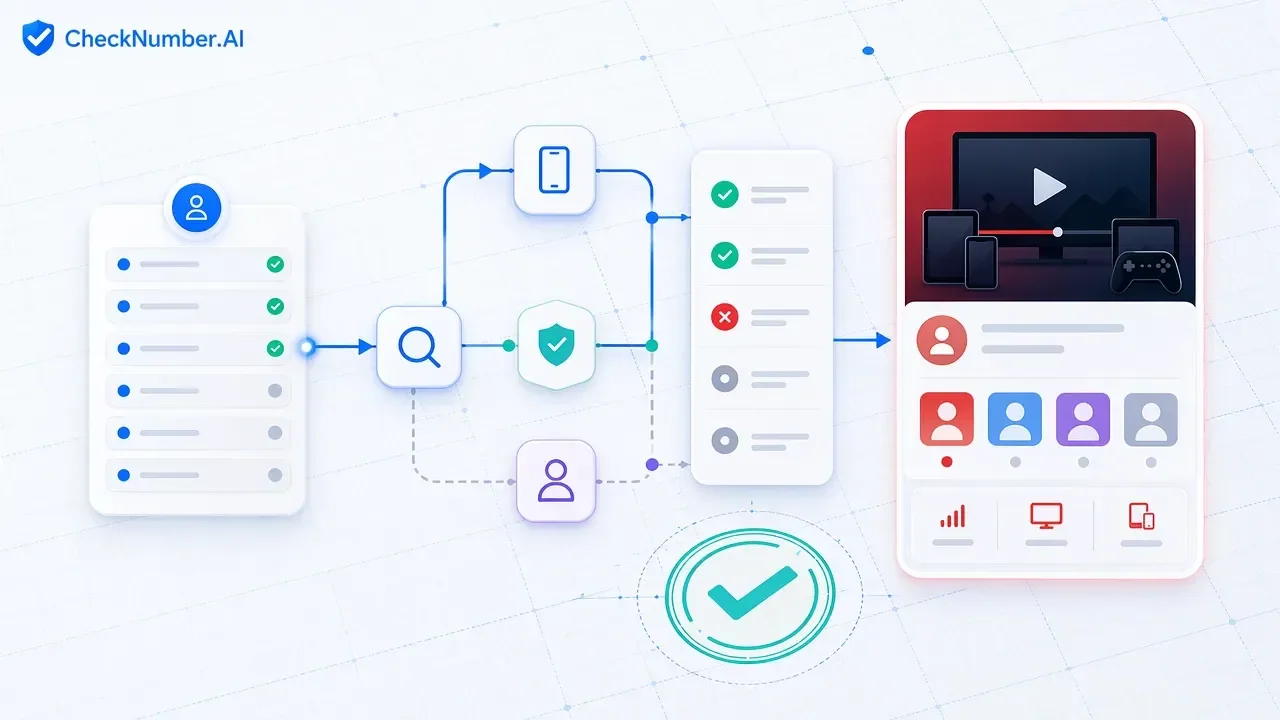
Netflix account detection by phone number can be framed as a supporting verification signal for risk, compliance, and account intelligence workflows. The practical idea is simple: if a number appears to be associated with an active streaming account, it may offer an additional layer of confidence when businesses are evaluating legitimacy, prioritizing review, or deciding how much friction to apply in a verification flow. In an enterprise setting, that makes it useful as one signal within a larger verification platform rather than as a one-off lookup.
→ Start verifying — get 1,000 free checks →
Why phone-number-linked signals matter
Phone numbers are often treated as one of the more operationally useful anchors in digital identity workflows. They are used for account recovery, verification codes, step-up authentication, and general security controls across many consumer platforms, including streaming services.
That makes them interesting for B2B verification teams. A phone number that appears connected to a maintained consumer service can sometimes function as an auxiliary trust signal, especially when compared with lower-confidence records such as disposable or lightly used contact points.
The keyword here is auxiliary. This kind of detection should not be presented as conclusive identity proof. Its value comes from supporting a broader decision model, not replacing one.
Why Netflix is relevant in this context
Netflix uses phone numbers in account security and recovery flows, including verification scenarios tied to access and account protection. That matters because it suggests the number has a practical role within the service’s own trust framework.
For businesses building verification workflows, this creates a reasonable hypothesis: if a phone number is associated with an active Netflix account, it may signal a baseline level of persistence, usability, and digital legitimacy. That does not mean the user is automatically trustworthy, but it can make the number more informative than an unqualified contact record.
How businesses can use this signal
The strongest use cases are usually found in workflows where teams need one more lightweight clue before escalating to costlier checks or invoking heavier verification steps.
Fraud and risk review
Risk teams often need a way to separate low-confidence records from those that appear more stable. A positive account-detection signal may help reduce uncertainty in early-stage screening.
Identity support workflows
In onboarding or account review, a detected streaming association can contribute to a layered picture of the user. It should be interpreted alongside device, behavior, location, and first-party data rather than in isolation.
Prioritization logic
Operations teams can use the signal to help route records. For example, a higher-confidence number may move through a lower-friction path, while weaker or ambiguous submissions may be flagged for deeper review.
Dataset qualification
If a business is trying to improve the quality of a phone-based dataset, account detection may help distinguish more plausible numbers from obviously lower-value entries.
Why this should stay a “supporting” signal
It is easy to overstate the value of alternative account data. That is where many implementations go wrong.
A Netflix account detection result should not be treated as:
- proof of identity;
- proof of ownership;
- proof of intent;
- proof of low fraud risk.
Instead, it should be treated as one more input in a broader model. A mature verification workflow balances this kind of signal against internal records, user behavior, explicit consent flows, and, where relevant, stronger KYC or compliance steps.
That framing is not just safer. It is also more useful operationally, because it keeps teams from assigning too much weight to a single external clue.
The compliance side matters just as much
Any workflow involving phone-number-based account signals has to be handled carefully from a privacy and governance perspective.
At a minimum, businesses should think about:
- whether the verification step is necessary for the stated business purpose;
- whether the workflow is transparent and consent-aware where required;
- whether only the minimum useful output is retained;
- whether the result is used proportionately rather than as an opaque profiling shortcut.
This is especially important for businesses operating in Europe, where proportionality, lawful basis, and data minimization are not abstract ideas but practical regulatory obligations. The more this signal is embedded into a reusable verification workflow, the more important that governance layer becomes.
FAQ
Is Netflix account detection by phone number the same as identity verification?
No. It is better used as an auxiliary signal that may support a broader verification or fraud-review workflow.
Does a positive result mean the user is low risk?
Not by itself. It may strengthen confidence in a record, but it should never replace broader review logic.
Why would operations teams care about this signal?
Because it can help prioritize records, reduce unnecessary friction for cleaner cases, and improve the quality of phone-based datasets.
What is the biggest implementation risk?
Overinterpreting the signal. Treating it as definitive proof creates both compliance and decision-quality problems.